What must the code prove?
Presence only, readable print, the correct date, the correct batch or lot, an approved format, product-to-code agreement—or a combination.
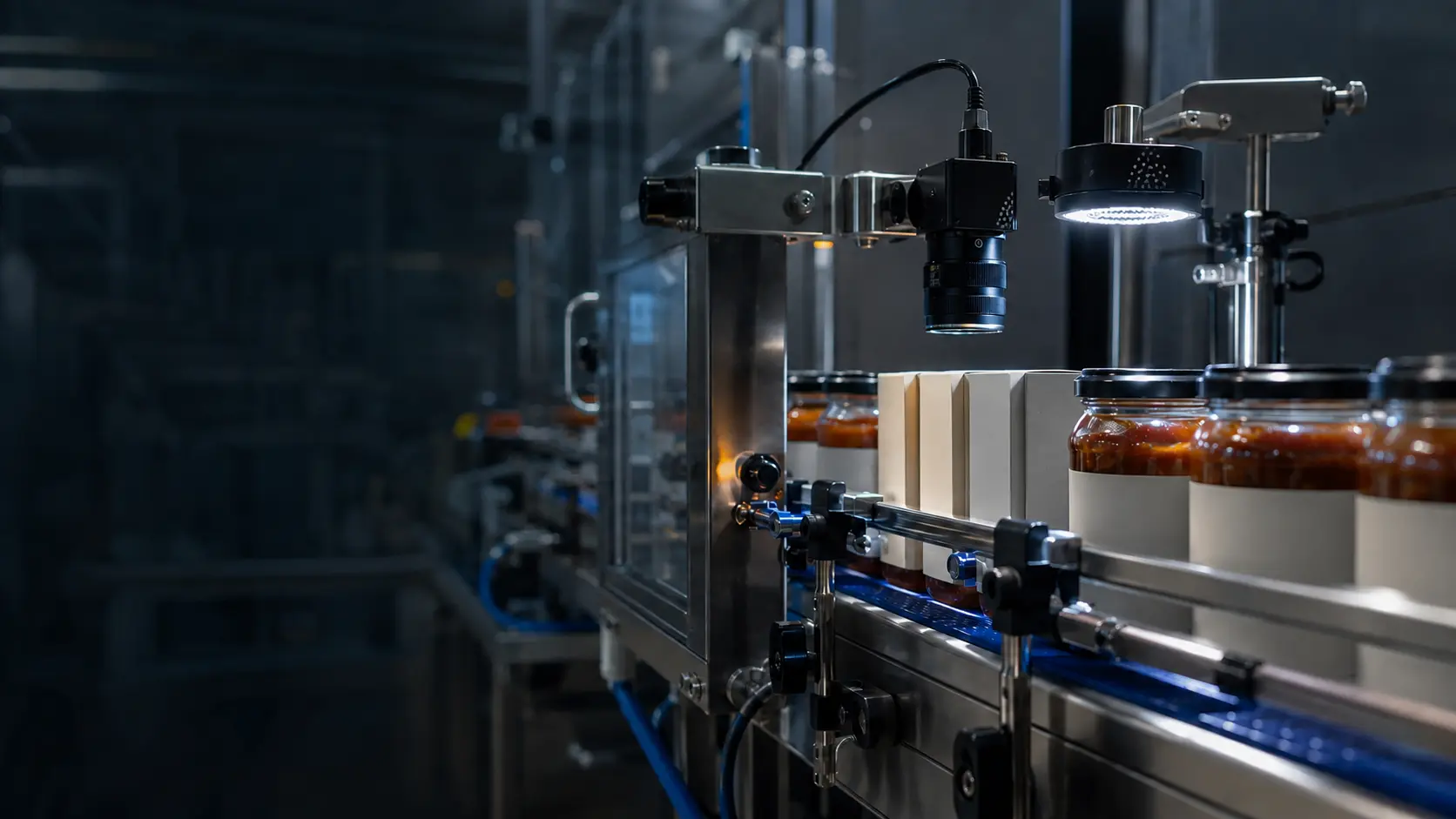
Define what the printed code must prove, how the product will be presented and what the line must do when a check fails.
Presence only, readable print, the correct date, the correct batch or lot, an approved format, product-to-code agreement—or a combination.
A fixed recipe, shelf-life calculation, operator entry, PLC, printer, MES, database or job-management system.
Define orientation, spacing, conveyor speed, movement, curvature and the permitted variation in code position.
Camera resolution, lens, field of view, exposure and lighting geometry must suit the smallest character and substrate.
Choose presence, pattern, OCR, OCV or a trialled AI-assisted method according to how much the content and appearance can vary.
Alarm, stop, track and reject, confirm removal, monitor the reject bin or escalate repeated failures.
Counters, read strings, timestamps, failure classifications, selected images and production-system events.
The best method is the simplest approach that remains stable across genuine good production and rejects every unacceptable fault.
| Method | Best suited to | Typical output | Key consideration |
|---|---|---|---|
| Presence / pattern | Proving a code or known feature exists | Pass or fail | Does not necessarily identify every character |
| OCR | Reading changing or previously unknown strings | Captured text plus confidence | Font, print quality and segmentation affect reliability |
| OCV | Confirming a known expected string | Match or mismatch by character | The expected value must be supplied correctly |
| AI-assisted vision | Applications with broad, representative good-print variation | Classification, read or anomaly result | Requires suitable training and validation samples |
AI is not a substitute for clear acceptance criteria. It should be selected only when trials show it improves robustness for the real application.
Reliable inspection treats product handling, image capture, code logic and reject control as one timed process.
Guide and space the product so the complete code enters a repeatable field of view.
Trigger the camera and lighting to freeze the printed field at production speed.
Apply presence, print-quality, OCR, OCV, format and data-comparison rules.
Pass, reject or stop, then record the result required by the production risk.
The camera first has to see and interpret the mark. The control logic then has to decide whether that observed value is authorised for the current product.
| Requirement | Typical route | Planning page |
|---|---|---|
| Known printed value | OCV or pattern comparison | OCV verification |
| Changing human-readable text | Conventional or AI-assisted OCR plus expected-data checks | OCR / AI OCR |
| MFG or production-date logic | OCR plus format, calendar and shelf-life rules | Manufacturing-date inspection |
| Encoded product and traceability data | 1D or 2D reading plus field validation | Barcode & Data Matrix |
| Correct packaging and variable print | Label identity plus date, batch and recipe agreement | Label & date verification |
| Hardware architecture | Smart camera, fixed reader, PC-based or multi-camera station | Camera & reader systems |
Use the answers as a starting point, then prove the final method with representative products and print.
Representative good and bad packs, code examples, permitted formats, line speed, product spacing, conveyor dimensions, printer details, changeover rules, reject requirements and the source of the expected data are the most useful starting points.
Use OCR when the system must read a changing or previously unknown string. Use OCV when the expected value is already known and the task is to confirm that the printed characters match it. Some applications combine both.
No. Controlled codes often achieve a clearer and more explainable result with OCR, OCV or pattern tools. AI-assisted vision is considered when genuine good-print variation is too broad for a stable rule-based method.
Yes. Depending on the required scope, the system can retain counters, timestamps, failure reasons, read strings and selected images. Storage duration and data exchange should be defined during specification.
Useful official background: GOV.UK food information guidance and mandatory food-label information.
Share the packs, code formats, line drawing and required failure response. We will identify the practical next step.
OCV verifies printed characters against a known expected value; OCR reads characters into data where the value may vary. The right method depends on whether the expected message is controlled, how variable the code is and what evidence the production record must retain.