Smart-camera systems
Compact processing at the inspection point for focused single-view applications.
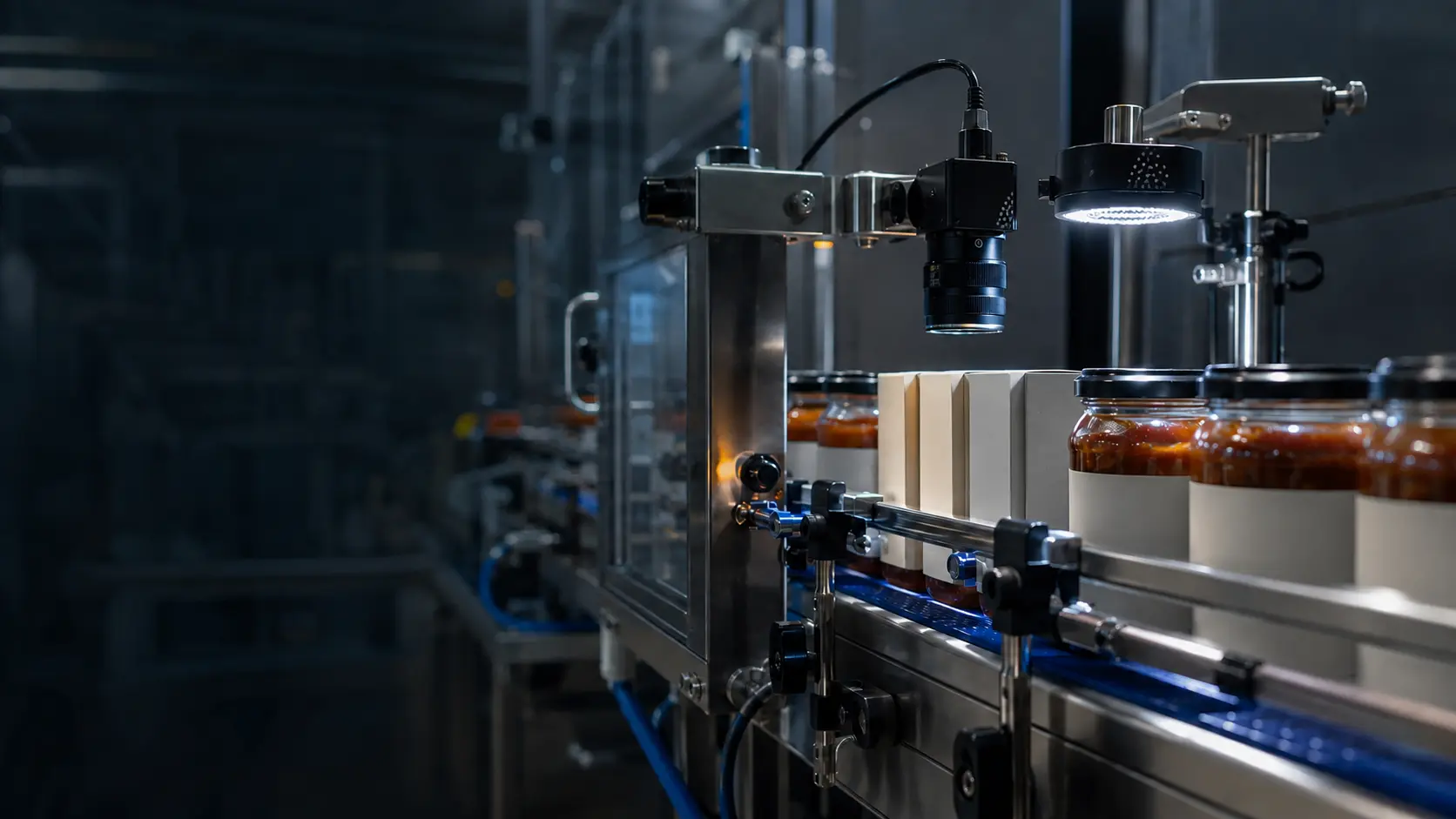
Integrate the camera, lens, lighting, trigger, software, controls and reject system needed to read and verify date, batch and lot codes at production speed.
A date-code camera system captures the printed region as each product passes, then uses presence, OCR, OCV, pattern or code-reading tools to return a controlled result. The reader can compare observed content with the current recipe and signal pass, reject, alarm or line stop.
Camera resolution alone does not make the inspection reliable. Product position, motion, code size, exposure, lens choice, lighting angle, reflections and surface shape determine whether the required defect remains visible at full line speed.
Compact processing at the inspection point for focused single-view applications.
Flexible multi-camera processing, interfaces and result handling for wider inspection scopes.
Purpose-selected code reading for barcodes, 2D symbols and supported OCR tasks.
Frame, guarding, lighting, controls, HMI, conveyor and reject where the line needs a turnkey module.
The correct architecture is the least complex design that proves every required failure mode under real production conditions.
A compact device for controlled code position, limited fields and straightforward line signals.
Camera, lighting, HMI, recipe logic, PLC communication and tracked rejection.
Several code faces, product views or combined packaging checks managed under one recipe.
A useful specification begins with the smallest defect and required field—not a preferred camera model.
| Production input | Why it matters | Design consequence |
|---|---|---|
| Character size | Sets the pixel detail available for OCR and print defects | Resolution and field-of-view selection |
| Line speed | Controls motion distance during exposure and result timing | Exposure, lighting power and processing budget |
| Product presentation | Changes code location, angle and focus | Guides, trigger strategy and depth of field |
| Surface and print | Creates glare, low contrast, distortion or texture | Lighting geometry, wavelength, polarisation and optics |
| Reject distance | Determines how a failed item is tracked | Encoder or sensor logic, actuator timing and confirmation |
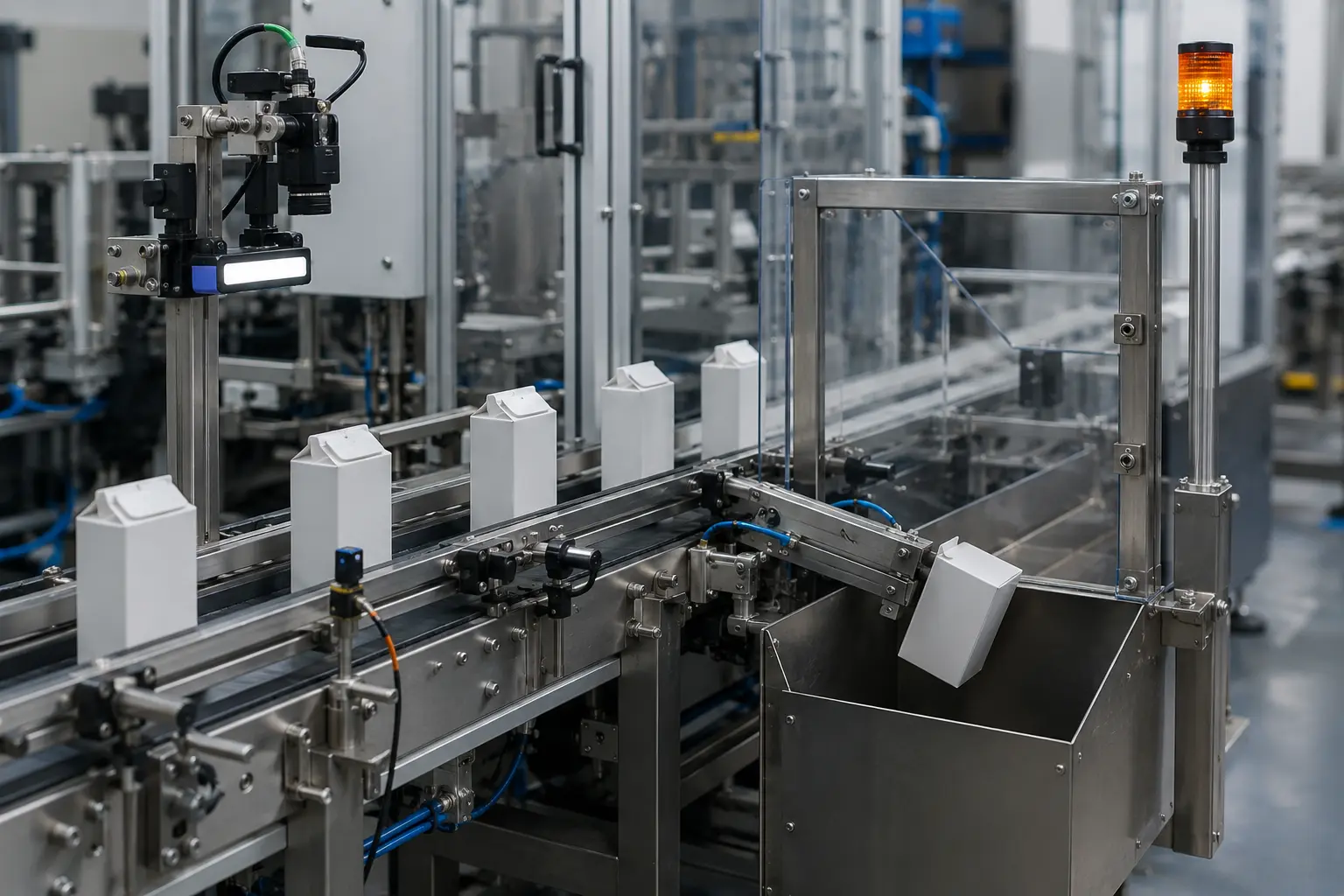
We request representative good production, edge-of-tolerance print and known failures. Trials reproduce the proposed view and lighting, then test code movement, location and appearance variation before the mechanical and controls scope is finalised.
For a retrofit, the survey also checks conveyor stability, available mounting space, electrical interfaces, guarding and reject distance. Where the existing line cannot present products consistently, a dedicated conveyor or handling module may be the more reliable solution.
Use the related pages to define the recognition method, source of expected data and physical line response.
Final performance is established with representative products, deliberate faults and the operating conditions found on your production line.
A date-code reader is an industrial camera or fixed reader configured to capture printed or encoded information and return a result. A complete inspection system also includes image control, expected-data logic and the required line response.
Some smart cameras process OCR, OCV and vision tools on the device. Whether that is suitable depends on the number of fields, interfaces, records, user controls and performance required.
One may be sufficient when every code is visible in one field of view at adequate resolution. Multiple cameras are considered for different pack faces, orientation variation, wide fields or combined packaging checks.
Often, yes. The survey confirms mounting space, product stability, code visibility, line signals, reject distance and safe access. A standalone conveyor module can be supplied where the existing line is unsuitable.
Send a line video, pack dimensions, code samples, speed and the faults you must reject. We will identify the practical camera-system architecture.